3KW Fiber laser welding machine, as core precision equipment in modern manufacturing, use high-purity optical fibers as the gain medium and leverage the high-energy-density laser beam generated by rare-earth element-doped fibers to achieve precise welding of various metal materials. Their core working principle involves diode-pumped excitation of the fiber to generate a 1070nm near-infrared laser, which is then transmitted to the welding head via a flexible fiber. A collimating and focusing lens system compresses the laser beam into a micrometer-scale spot, achieving an instantaneous energy density on the order of 10⁶ W/cm². This rapidly melts the metal material and forms a strong weld, making it suitable for both precision welding of micro-parts and deep-penetration joining of thick plates.
Why use 3KW Fiber laser welding machine to replace manual welding?
Fiber laser welding machines, as benchmark equipment for precision welding in modern industry, have achieved breakthroughs in precision, efficiency, and adaptability thanks to their unique technical principles and structural design. They comprehensively meet the needs of high-end manufacturing and have become key equipment driving the transformation and upgrading of various industries. Their core advantages are as follows:
I. Precision Welding, Unparalleled Weld Quality
Relying on excellent beam quality, the laser beam can be stably controlled after focusing, enabling precise welding of micro-components and complex weld seams.
The heat input is highly concentrated during welding, and the width of the heat-affected zone can be controlled within 0.5mm, resulting in minimal thermal deformation. The weld surface is smooth, free of porosity and spatter, eliminating the need for subsequent grinding and polishing in most scenarios, significantly reducing post-processing costs.
II. Highly Efficient and Energy-Saving Operation, Significantly Improving Production Efficiency
The electro-optical conversion efficiency reaches 30%-50%, far exceeding that of traditional YAG lasers (3%-10%). Energy consumption is reduced by more than 50% compared to traditional welding equipment, resulting in significant savings in electricity costs over long-term operation. At a power level of 1500W, the welding speed for 1-4mm stainless steel/carbon steel can reach 8-15m/min, which is 5-10 times faster than traditional TIG/MIG arc welding, significantly shortening the production cycle.
The equipment supports simultaneous multi-beam processing and automated integration, seamlessly adapting to six-axis industrial robots to achieve 3D complex trajectory welding and mass production. With offline programming and teaching functions, manual alignment is eliminated, reducing human error. Under the same parameters, the welding quality fluctuation is less than 3% after 100,000 welds, demonstrating extremely high stability and effectively improving the overall efficiency and yield of the production line.
III. Flexible Non-Contact Processing, Adaptable to Complex Scenarios
Utilizing flexible fiber optic laser beam transmission, energy loss is extremely low, enabling long-distance, non-contact welding. This easily handles complex structures, confined spaces, or large workpiece welding areas that are difficult for traditional welding equipment to reach. The welding head structure is lightweight, and some handheld models support mobile operation. Combined with fiber optic anti-bending protection design, it facilitates flexible operation in scenarios such as advertising production, large mold making, and automotive repair.
IV. Broad Material Compatibility, Overcoming Bottlenecks in Dissimilar Metal Welding
It possesses extremely strong material compatibility, enabling stable welding of various metals including stainless steel, carbon steel, aluminum alloys, copper alloys, titanium alloys, and nickel alloys, as well as highly reflective materials such as copper and aluminum. By optimizing laser parameters (wavelength, pulse width, frequency), it effectively solves the industry-wide problem of unstable welding of highly reflective materials.
It has a wide range of welding thickness adaptability, with single-pass welding thicknesses covering 0.05-32mm (continuous laser models). It can achieve non-reflow welding of thin materials (below 0.1mm) and deep penetration welding of medium-thick plates (6-8mm carbon steel), without the need for preheating treatment, adapting to welding needs across all scenarios from microelectronic components to heavy machinery.

Laser source
MAX/Raycus, a well-known Chinese brand, is available as an option
High beam quality: Near-Gaussian beam with excellent focusing, suitable for precision machining.
High conversion efficiency: Photoelectric conversion efficiency reaches 30%-40%, more energy-efficient than traditional lasers.
Strong stability: All-fiber structure, vibration-resistant, dust-resistant, and temperature-variable resistant, with a long maintenance-free cycle.

Water chiller
The system employs a compression refrigeration cycle, in which the refrigerant undergoes a "compression-condensation-throttling-evaporation" cycle to absorb heat from the cooling water and release it to the outside. The cooled water is then circulated through pipelines to the heating components of the welding machine, where it completes heat exchange before returning to the water chiller for further cooling. This closed-loop temperature control precisely maintains the equipment's operating temperature.

Control system
The SUP fiber optic welding machine control system is a dedicated control system adapted for handheld/small-format fiber optic welding. Centered around a touchscreen and control box, it integrates process parameter management, real-time monitoring, and multiple safety protections.

Laser gun
The SUP fiber welding laser gun (also known as the SUP handheld laser welding head) is a handheld/small-area welding execution component adapted to ≤3000W fiber lasers. It features lightweight construction, multi-process integration, and easy maintenance.

Cleaning components
The cleaning component of a fiber laser welding machine is a laser cleaning auxiliary module adapted to the welding machine. It utilizes the high energy density of the laser to achieve non-contact decontamination and can be quickly switched to welding function, realizing "welding and cleaning in one". It primarily removes rust, oil, scale, welding slag, and other impurities from the workpiece surface before and after welding, improving welding fusion and weld quality.

Wire feeder
Provides continuous and stable filler wire for laser welding, filling workpiece gaps, optimizing weld formation, and improving weld strength, suitable for medium and thick plate welding, gap workpiece welding and other scenarios.

Device Name | Laser Welding Machine |
Equip model | 1500W/ 2000W/ 3000W |
Laser source | MAX Brand |
Laser gun | SUP Laser Gun |
Control system | SUP Control System |
Water chiller | S&A Water Chiller |
Gun end cable length | 10 m /15 m |
Other equipment | Auto wire feeder,Protective lenses, Optical fiber cables, toolbox, etc. |
Voltage | 220V 50Hz/60Hz; 380V 50Hz/60Hz; |
Warranty | 1 years (not include wearing parts) |
Device Name | Laser Welding Machine |
Equip model | 1500W/ 2000W/ 3000W |
Laser wavelength | 1070nm |
Interface of fiber-optical | QBH |
Module life | 100000hours |
Samples

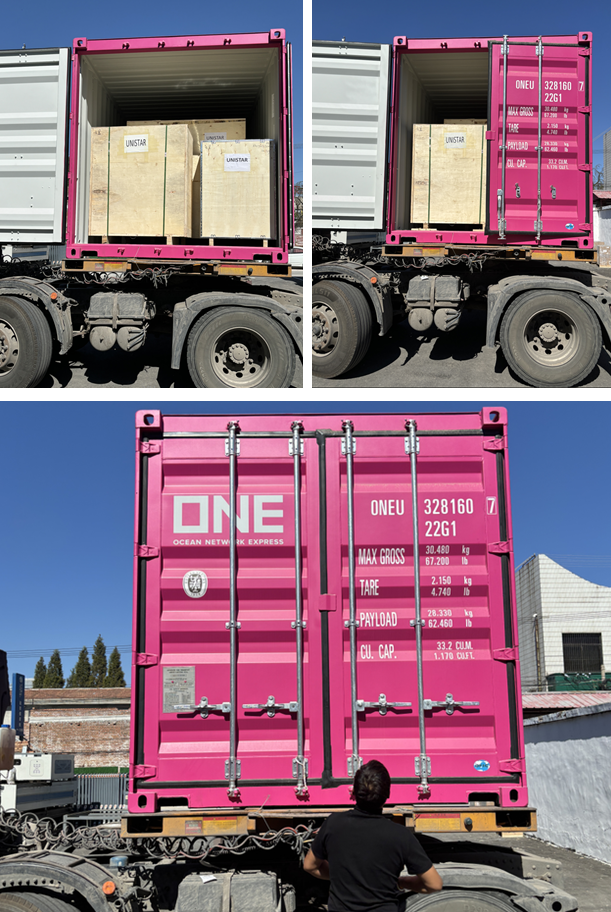
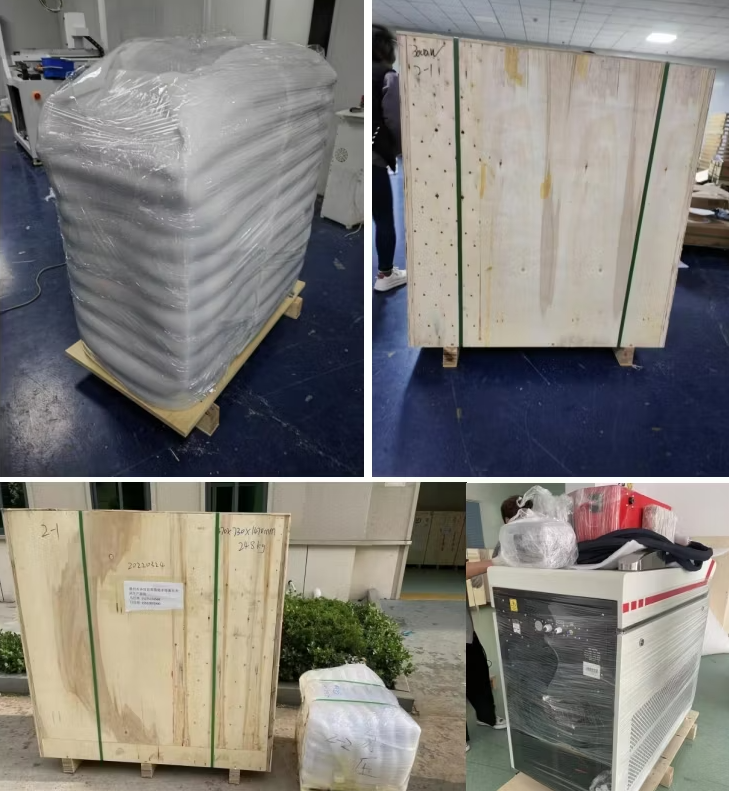
3KW Fiber laser welding machine Factory Showcase

FAQ
Q: Why is there no laser light emitted after powering on?
A: ① The water chiller was not started first, or the water temperature/flow rate of the water chiller is abnormal, triggering the interlock protection; ② The laser gun safety lock is not in contact with the workpiece, or the emergency stop button is not reset; ③ The laser enable in the control system is not turned on, or the power setting is 0.
Q: What is the correct power-on and power-off sequence for a fiber laser welding machine?
A: Power-on: Water chiller → Wire feeder (optional) → Welding machine control system → Trigger laser enable; Power-off: First, turn off laser enable → Turn off welding machine control system → Wire feeder → Finally, turn off the water chiller.
Q: What is the optimal distance between the laser gun tip and the workpiece when handheld laser welding?
A: The standard focusing distance is 10-15mm (specific distance depends on the laser gun model). The laser gun tip must be kept perpendicular to the workpiece. Too close a distance can easily burn the protective lens, while too far a distance will result in a sparse laser spot and insufficient weld penetration.
Q: How to solve the problem of porosity and slag inclusions in the weld after welding? A: ① Thoroughly remove rust, oil, and scale from the workpiece surface using the laser cleaning assembly; ② Check the gas path, clear any blockages in the air nozzles, and adjust the shielding gas pressure to 0.3-0.5 MPa; ③ Appropriately reduce the wire feed speed and match the laser power to ensure complete melting of the welding wire.
Q: Uneven weld formation, with undercut and burn-through, how to adjust parameters? A: Undercut and burn-through (thin plates): Reduce laser power, increase welding/scanning speed, and reduce the laser spot size; Weld depression and poor formation: Appropriately increase the wire feed speed, increase laser power, or reduce welding speed and optimize the scanning oscillation width.
Look forward to hearing from you
Quick Links
JINAN UNISTAR MACHINERY CO., LTD.
WhatsApp: +86 150 6402 1290
E-mail: admin@unistarcnc.com
WeChat : +86 150 6402 1290
QQ: 871075113
Get In Touch


 عربي
عربي  Русский
  Français
  한국인
한국인  Español